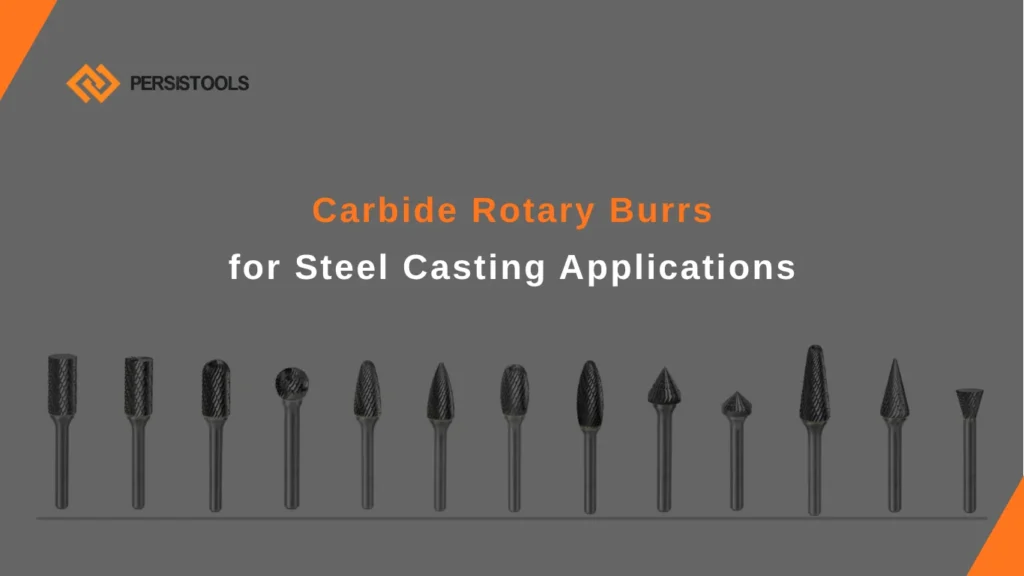
The steel casting industry is characterized by heavy-load processing, complex workpiece shapes and high requirements for surface quality. As an indispensable precision grinding tool, carbide rotary burrs play a key role in improving processing efficiency, ensuring product quality and reducing production costs in steel casting production, processing and maintenance.
Unlike ordinary grinding tools, rotary burrs can adapt to the harsh working conditions. This article will introduce how carbide burrs are applied in the steel casting industry, including core application scenarios, correct usage methods and material selection skills, to help steel casting factories and buyer use rotary burrs efficiently.
Main Application Scenarios of Rotary Burrs in the Steel Casting Industry
In the whole process of steel casting, from raw casting trimming to finished product polishing, rotary burrs are widely used. They can replace traditional manual files and small grinding wheels, realizing mechanized processing, reducing labor intensity and improving processing efficiency by 3 to 5 times compared with small grinding wheels. The specific application scenarios are as follows:
1.Deburring and Trimming of Raw Steel Castings
After steel casting molding, burrs, flash and excess metal materials will inevitably remain on the surface and edge of the casting, especially at the pouring gate, riser and mold joint. These defects will affect the subsequent processing and assembly of the casting and even cause potential safety hazards. Rotary burrs are the most efficient tool for solving this problem.
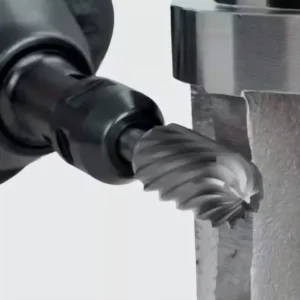
When in use, match the rotary burr with a high-speed pneumatic or electric die grinder. Select the appropriate shape (such as cylindrical SC shape, ball-head SD shape or conical SM shape) according to the position of the burr. (More information about the shapes of carbide burrs refers to For large-area burrs and flash at the pouring gate, use a double-cut rotary burr to quickly remove excess materials. For small burrs at the edge and corner of the casting, use a single-cut rotary burr to ensure that the casting surface is smooth without damaging the base material. It is the most basic and widely used application of carbide burrs in the steel casting industry.
2.Weld Grinding and Finishing of Casting Assemblies
In the steel casting industry, many large castings such as casting frames, machine tool bases, and marine casting components need to be assembled by welding. The weld seam after welding is uneven, and there will be welding spatter and slag, which not only affects the appearance but also reduces the structural strength and corrosion resistance of the casting assembly.
Rotary burrs are suitable for grinding and finishing weld seams of steel castings. Compared with traditional grinding tools, rotary burrs can grind narrow weld seams and hard-to-reach areas, for example, the inner wall of casting holes and the joint of complex structures, more flexibly and accurately.
3.Precision Trimming of Complex Casting Parts
Many steel castings (such as casting impellers, valve cores, and mold cavities) have complex shapes, narrow channels and irregular inner holes. Ordinary grinding tools are difficult to reach and polish these areas.
The small size (3mm Shank) carbide burrs can perfectly adapt to the polishing of complex casting parts. For example, when trimming the flow channel of a casting impeller, select a flame-shaped (or tree-shaped rotary burr to grind the inner wall of the flow channel smoothly, ensuring the fluidity of the medium. When trimming the inner hole and groove of a complex casting, use a cylindrical rotary burr to ensure the dimensional accuracy of the hole and groove, making the assembly of the casting more precise. This application is particularly important in the production of high-precision steel castings, which can effectively improve the product quality.
4.Surface Treatment Before Casting Coating
Steel castings need to be coated to prevent corrosion and extend service life. The surface of the casting must be smooth and free of rust, oil stains and unevenness before coating, otherwise, the adhesion of the coating will be affected, leading to coating peeling and corrosion of the casting.
Rotary burrs are used for surface treatment of steel castings before coating. Use rotary burr to polish the surface of the casting, remove rust, oxide skin and uneven parts, and make the casting surface have a certain roughness. This process can reduce the rework rate of coating and save the production costs.
Key Notes for Using Rotary Burrs in Steel Casting Industry
1.Match the appropriate rotary burr shape and tooth type according to the processing scenario: single-cut rotary burrs are suitable for general-purpose grinding of ferrous materials such as steel castings, with good material removal effect and smooth finish. Double-cut rotary burrs are suitable for rapid material removal of hard steel castings, with better operator control.
2.Control the rotating speed of the die grinder: the rotating speed should be matched according to the diameter of the rotary burr. Generally, the smaller the diameter of the rotary burr, the higher the rotating speed. For steel castings, it is recommended to use a medium-high speed to ensure processing efficiency and avoid tool damage due to too low speed.
3.Avoid excessive force during use: let the rotary burr work at a constant speed, and do not apply excessive pressure, otherwise, it will easily lead to edge chipping, tool breakage and uneven processing surface.
4.Regularly check the wear of the rotary burr: replace the worn rotary burr in time to ensure processing quality and efficiency. The service life of carbide rotary burrs is 10 times that of high-speed steel tools and 50 times that of small grinding wheels, which can greatly reduce tool replacement costs.
Conclusion
In the steel casting sector, carbide rotary burrs is an essential, high-efficiency grinding solution for the full workflow from blank trimming to final coating. Pairing the suitable carbide burrs with proper operation will maximize their performance and deliver greater economic value to steel casting businesses.
As a manufacturer dedicated to the R&D and production of high-end rotary burrs, Persistools have rich experience in the application of rotary burrs in the steel casting industry. We can provide standard rotary burr products suitable for steel casting processing and customized solutions according to customer specific needs. Our products adopt high-quality raw tungsten carbide materials, through strict quality control, to ensure stable performance and long service life.
We are committed to providing professional products and services, helping customers improve processing efficiency and reduce production costs. Feel free to get in touch with us if you need a trustful carbide rotary files supplier!