
In the mold processing industry, precision, efficiency and cost are the core competitiveness of enterprises, and the choice of cutting tools directly determines the processing quality and production capacity. Carbide burrs, with the advantages of wear resistance, strong adaptability and easy operation, have replaced traditional hand files and small shank grinders, becoming the core tool for the whole process of mold rough machining, finish machining and repair. They are widely used in the processing of various molds such as injection molds and die-casting molds.
Core Characteristics of Carbide Burrs, Adapting to All-Scenario Needs of Mold Processing
Carbide burrs are used with high-speed electric grinders or pneumatic tools. Compared with traditional tools, they can better meet the needs of refined and efficient mold processing.
First of all, wide processing range and strong adaptability. Carbide burrs can process various metal materials below HRC70, covering common materials in mold processing, so there is no need to change tools frequently. High-quality carbide burrs can reach a hardness of more than HRA92, which can easily handle high-hardness mold steel and avoid edge chipping and excessive wear.
Secondly, high processing precision and excellent surface quality. Carbide burrs made by numerical control have stable parameters, with a concentricity deviation of ≤0.01mm, no obvious vibration during high-speed operation, and the processed surface finish can reach Ra0.8. This reduces the subsequent polishing process and the rework rate.
Thirdly, high efficiency and low comprehensive cost. The processing efficiency of carbide burrs is dozens of times that of hand files and nearly ten times that of small shank grinders. Their service life is much longer than that of high-speed steel tools and alumina grinders, reducing the cost of tool replacement. In addition, there is no dust pollution, which improves the working environment and reduces the labor intensity of workers.
Finally, easy operation and safe reliability. They can be installed on electric tools, pneumatic tools or machine tools for use, with adjustable speed (6000-40000 revolutions per minute), and can be operated after being clamped firmly and correctly. High-quality carbide burrs adopt high-strength welding, which will not loosen or fall off during high-speed operation, ensuring safety.
Specific Application Scenarios of Carbide Burrs in the Mold Processing Industry
Rotary files have penetrated into the whole process of mold processing, with four core application scenarios covering key links such as rough machining, finish machining and repair.
Scenario 1: Rough Machining and Finish Machining of Mold Cavities
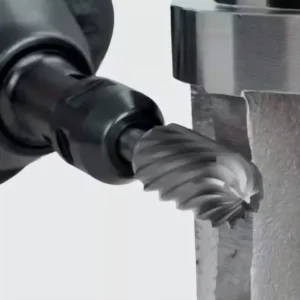
Mold cavities have complex shapes and high precision requirements. With various tool types and excellent cutting performance, carbide burrs can efficiently complete rough and finish machining. In the rough machining stage, they quickly remove excess material from the mold blank and clean up burrs. In the finish machining stage, they trim the curved surfaces, inner holes and other parts of the cavity, remove the metamorphic layer caused by EDM, ensure the dimensional accuracy and surface finish, and improve the mold forming effect.
Scenario 2: Processing of Mold Edges, R Angles and Runner
The processing of edges, R angles and runner directly affects the service life of the mold and the product quality. Carbide burrs can go deep into narrow areas to accurately complete rounding, chamfering and trimming of runner and gate, ensuring smooth runner, avoiding mold stress concentration and product burrs. The R angle error of precision molds can be controlled within ±0.01mm.
Scenario 3: Mold Repair and Renovation
Molds are prone to wear, scratches and other problems after long-term use. Direct scrapping will increase costs. Carbide burrs can accurately process worn parts and trim after welding, quickly restore the precision and surface quality of the mold, extend its service life, improve the mold reuse rate and reduce procurement costs.
Scenario 4: Custom Processing of Non-Standard Molds
The demand for non-standard molds is increasing day by day. Carbide burrs can be customized with special length, tool type and tooth shape according to needs, adapting to complex processing requirements. Regular manufacturers can complete sample making in 3-5 days, ensuring the batch stability of products and providing support for the efficient processing of non-standard molds.
Precautions for Using Rotary Files in Mold Processing
- Clamp firmly and correctly to avoid high-speed vibration. The cutting direction should move evenly from right to left, do not cut back and forth or use excessive force, and wear protective glasses during operation.
- Adjust the speed reasonably. The operating speed of cemented carbide rotary files should be controlled at 1500-3000 surface feet per minute, adjusted according to the diameter and material, to avoid too high or too low speed.
- Use with lubricant, drop it to the file head regularly to reduce friction, lower cutting heat, extend service life and improve surface quality.
- Replace or regrind the blunt file head in time to avoid damaging the file tool and equipment due to excessive force and reduce additional losses.
- Avoid the file shank touching the workpiece to prevent the file tool from overheating and damaging the welding joint, ensuring the safety and service life of use.
Conclusion: Carbide Burrs Help the High-Quality Development of the Mold Processing Industry
With the continuous upgrading of the mold processing industry, the requirements for processing precision, efficiency and cost control are getting higher and higher. As an efficient, precise and durable cutting tool, carbide burrs will be more widely used in mold processing. From mold cavity processing to edge trimming, from mass production to non-standard customization, from mold processing to mold repair, carbide burrs, with their unique advantages, effectively solve the pain points of traditional tools such as low processing efficiency, poor precision and fast wear, helping mold processing enterprises reduce comprehensive costs, improve production efficiency and optimize product quality.
For many years, Persistools have been researching and developing the application of carbide burrs in the mold industry. With the development of processing technology and materials, we continue to upgrade towards more refinement, customization and high efficiency. For various scenarios of mold processing, we develop ultra-fine grain tungsten carbide particle raw materials, and we can also customize special tooth shapes for customers according to the processing scenarios.
As a leading manufacturer deeply engaged in the field of mold processing carbide burrs, we always take quality as the core competitiveness. With stable product quality and efficient service, we have become a long-term partner of many mold processing enterprises, fundamentally helping customers reduce procurement risks, improve processing efficiency and achieve the goal of cost reduction and efficiency increase.