Grain Size, Hardness & Toughness Comparison
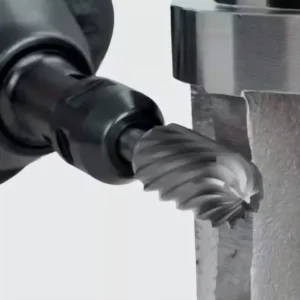
The core differences between the raw tungsten carbide materials used in high-quality rotary burrs lie in cobalt content and grain size. Currently, the two most widely used raw materials for rotary burrs in industrial processing are low-cobalt tungsten carbide and high-cobalt tungsten carbide. This article will detail the advantages, disadvantages and suitable working conditions of these two mainstream industrial-grade tungsten carbide materials.
Low-Cobalt Tungsten Carbide
Low-cobalt tungsten carbide refers to the material with 6% cobalt content, corresponding to ISO K10/K20 grades. It has a higher proportion of hard phase, finer and more uniform grain structure, high alloy density, higher microhardness and lower friction loss. It maintains a sharp cutting edge for a long time, and the workpiece surface after grinding is smooth with no obvious scratches.
Advantages: Higher overall hardness and excellent wear resistance, not easy to wear during long-term high-speed grinding; lower surface roughness of the processed workpiece, which can meet the needs of precision mold repair and high-gloss processing; good high-temperature friction resistance, suitable for high-speed and light-load grinding operations.
Disadvantages: Relatively weak impact toughness. When subjected to heavy load impact, severe collision or intermittent impact force processing, it is prone to edge chipping, tooth loss, tool body cracking and other problems. It is not suitable for rough heavy-load grinding scenarios.
High-Cobalt Tungsten Carbide
High-cobalt tungsten carbide has a higher cobalt content, usually 8% cobalt, corresponding to ISO K20/K30 grades. It has a stronger bonding phase structure, relatively larger grain size, more prominent overall toughness, and excellent impact and vibration resistance. It is a general material for industrial rough processing and heavy-load grinding.
Advantages: Excellent toughness, strong impact and bending resistance, not easy to break the shank or chip the head under harsh working conditions; can bear large cutting force, suitable for heavy-load scenarios such as casting deburring, weld grinding and forging rough processing; stable during intermittent cutting, greatly reducing the probability of tool fracture and failure.
Disadvantages: Slightly lower hardness than low-cobalt tungsten carbide, and slightly poorer wear resistance under long-term high-frequency friction; when used for high-speed precision polishing, the wear rate is relatively faster, making it difficult to achieve high-gloss processing effect.
Material Selection Guide for Carbide Rotary Burrs
In summary, low-cobalt tungsten carbide is more suitable for scenarios requiring high processing precision, such as stainless steel finishing, precision mold repair, cavity polishing, and high-gloss workpiece grinding (e.g., auto parts precision components, mold cavities).
High-cobalt tungsten carbide is more suitable for heavy industrial rough processing, such as cast iron casting deburring, weld grinding, forging rough processing, heavy industrial impact grinding, wood carving and other heavy-load scenarios (e.g., marine heavy industry, hardware casting).
Persistools have developed a special tungsten carbide grade for the production of high-quality rotary burrs, the ultra-fine grain tungsten carbide with 6% cobalt content. It adopts high-temperature pressing and vacuum sintering, using raw materials with uniform grains and no impurities. It has both ultra-high hardness and high wear resistance, which can stably adapt to various metal processing conditions and has a service life far ahead of ordinary products.
At the same time, we can customize the most suitable grade according to specific working conditions, such as shipbuilding, super-hard alloy grinding, aluminum processing and so on.
We are committed to creating continuous value for customers with high-quality products and professional services.
As a manufacturer dedicated to the continuous R&D and quality pursuit of high-end carbide burrs, we look forward to establishing long-term and stable cooperative relations with global partners and growing together in the field of industrial processing.