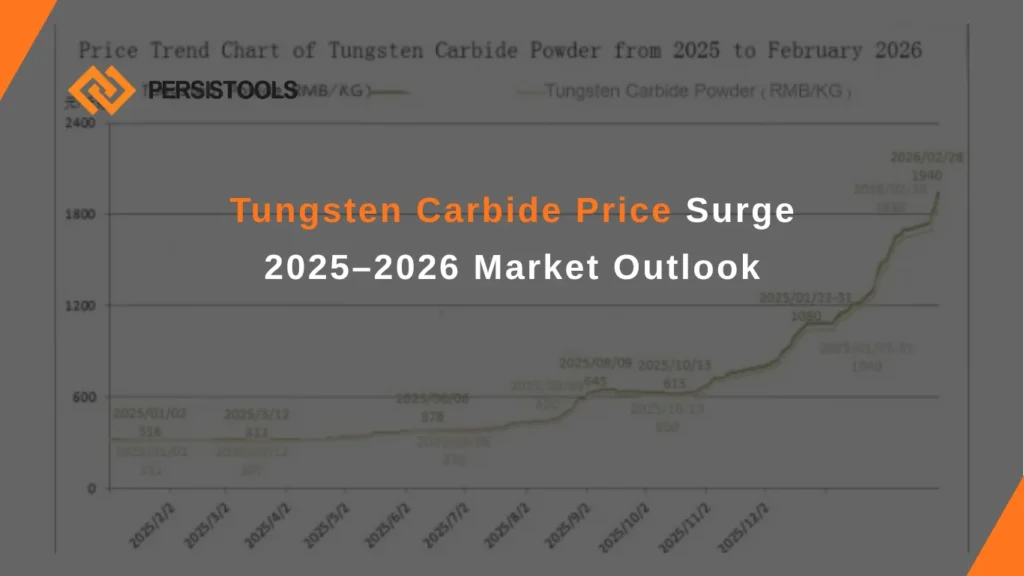
Since 2025, the global tungsten carbide market has seen an unprecedented price jump. From upstream tungsten concentrate and Ammonium Paratungstate (APT) to midstream tungsten carbide powder, key product prices have hit a 20-year high. As of April 2026, even with a short-term correction, tungsten carbide powder prices have still gone up by over 600% since the start of 2025. This has greatly affected the cost and supply chains of many industries, including cemented carbide cutting tools, military and new energy. This article looks back at the price trend from 2025 to April 2026, explains why prices rose so much, and gives a professional view on the future.
I. Tungsten Carbide Price Trend: 2025 Jan – 2026 Aprl
Phase 1: Jan – Mar 2025: Low and Stable
At the start of 2025, the market was quiet. The average price of tungsten carbide powder was only around 310 RMB (46 US$)/kg. In February 2025, China put export controls on tungsten products, which led to fewer export orders for a short time. But this policy changed the global tungsten supply chain and set the stage for the price surge later in the year.
Phase 2: Apr – Dec 2025: Steady Price Rise, Bigger Supply Shortage
From April 2025, the market changed dramatically, and prices started to rise non-stop. The main reason was China’s 2025 tungsten mining quota—down 6.45% from 2024 to 58,000 tons. This made the market worry about less supply, pushing prices up.
In the second quarter, environmental checks in major tungsten-producing provinces forced many small and medium mines and factories to cut or stop production. The industry’s operating rate dropped to 35%, making spot supplies tight. At the same time, more photovoltaic factories used tungsten wire, and military demand grew fast. By the end of 2025, tungsten carbide powder rose to 850 RMB (125 US$)/kg, up over 174% from the start of the year.
Phase 3: Jan – Mar 2026: All-Time High
In early 2026, prices jumped even faster. China cut the 2026 tungsten mining quota by another 8%—the third year in a row, with a total cut of 14% over three years.
Tungsten wire use in photovoltaic silicon wafer cutting rose to over 45%, and global solar power capacity kept growing. Global geopolitical tensions also increased military demand for tungsten. Traders stocked up, and big companies raised prices many times. In March 2026, tungsten carbide powder hit a record high of 2,400 RMB (352 US$)/kg—up over 641% from early 2025.

Phase 4: Apr 2026 Present: Calm Down, High and Stable
Since April 2026, prices have corrected a little. Small and medium factories downstream could not afford the high raw material prices, so they bought less. Some traders sold their stocks to take profits, and big companies lowered prices a bit to calm the market.
By late April 2026, tungsten carbide powder sold for 2,090-2,275 RMB (307 US$- 334 US$)/kg. Even with the correction, prices are still at an all-time high—up over 90% from the start of 2026. The market is now stable with tight supply and demand.
II. Why Tungsten Carbide Prices Surged (2025-2026)
The price surge was not just short-term speculation. It came from three main factors: less supply, more demand, and support from policies and capital. The big gap between supply and demand was the key reason.
1. Less Supply: Tight Controls Limit Output
China supplies over 80% of the world’s tungsten. Since 2025, three main controls have cut China’s tungsten supply, pushing prices up:
Lower mining quotas: China cut tungsten mining quotas for three years in a row—6.45% in 2025 and 8% in 2026, with a total cut of 14%.
Strict environmental rules: Many small and medium mines and factories have been closed or cut production since 2025. The industry’s operating rate stayed below 40%, making supplies tight.
Export controls: After China limited tungsten exports in February 2025, exports dropped 27.5% in 2025 and another 40% in January 2026. This made the global supply shortage worse.
2. More Demand: Growth in Many Industries
While supply was tight, demand for tungsten grew fast in many industries, making the supply gap bigger:
Photovoltaic (solar) industry: Tungsten wire is now used in over 45% of silicon wafer cutting (up from 20% in 2024). Global solar capacity is growing, so the photovoltaic industry may need 6,000-7,000 tons of tungsten in 2026.
Military: Global military demand for tungsten rose from 2,200 tons in 2024 to 3,000 tons in 2026, as geopolitical tensions grew.
Traditional manufacturing: Factories recovered in 2025, with more cemented carbide tools made. Big projects in infrastructure, shipbuilding and hydro-power also needed more tungsten carbide.
New industries: Tungsten use in new energy vehicles rose 22% in 2025 (it helps improve battery performance), and semiconductors also need more tungsten.
3. Policies & Capital: Push Prices Up
Capital also played a role: During the price rise, some traders stocked up to make more money, making supplies even tighter. Big companies raised prices many times, which pushed the market up. The April correction was just traders selling their stocks—not a change in the main market trend.
III. Future Outlook for Tungsten Carbide Market
Looking at supply, demand, policies and expert forecasts, the tungsten market will stay tight for a long time. Prices are unlikely to drop sharply, and the industry will enter a new period of “high and stable prices, better product quality”.
Short-Term Outlook (Q2-Q4 2026): High and Stable, Hard to Drop
For the rest of 2026, prices will stop rising sharply and enter a stable period with small changes. The main reason is that small and medium factories downstream can’t afford high prices, so they won’t buy more. But supply is still tight, so prices won’t drop much.
Price forecast: Tungsten carbide powder will likely sell for 1,800-2,200 RMB (264 US$-323 US$)/kg in 2026. This is much higher than 2025, and a sharp drop is very unlikely.
Long-Term Outlook: Strategic Value Grows, Better Products
In the long run, tungsten is a non-renewable resource with no good substitutes in key fields like high-end cutting, military, solar and semiconductors. Its value will keep growing, and the industry will focus on better, higher-quality products.
Big companies with tungsten resources and full production chains will have more advantages. At the same time, there will be more demand for high-quality tungsten carbide, and companies that can make these products will make more money.
As a manufacturer of high-end cemented carbide cutting tools, Persistools have over 10 years of experience in the tungsten carbide industry. We have stable raw material supplies and mature production technology, offering a full range of industrial-grade cemented carbide tools, as well as custom and OEM services. We will keep tracking tungsten carbide prices, providing global customers with stable, cost-effective products and professional supply chain solutions to deal with market changes and achieve long-term success together.