


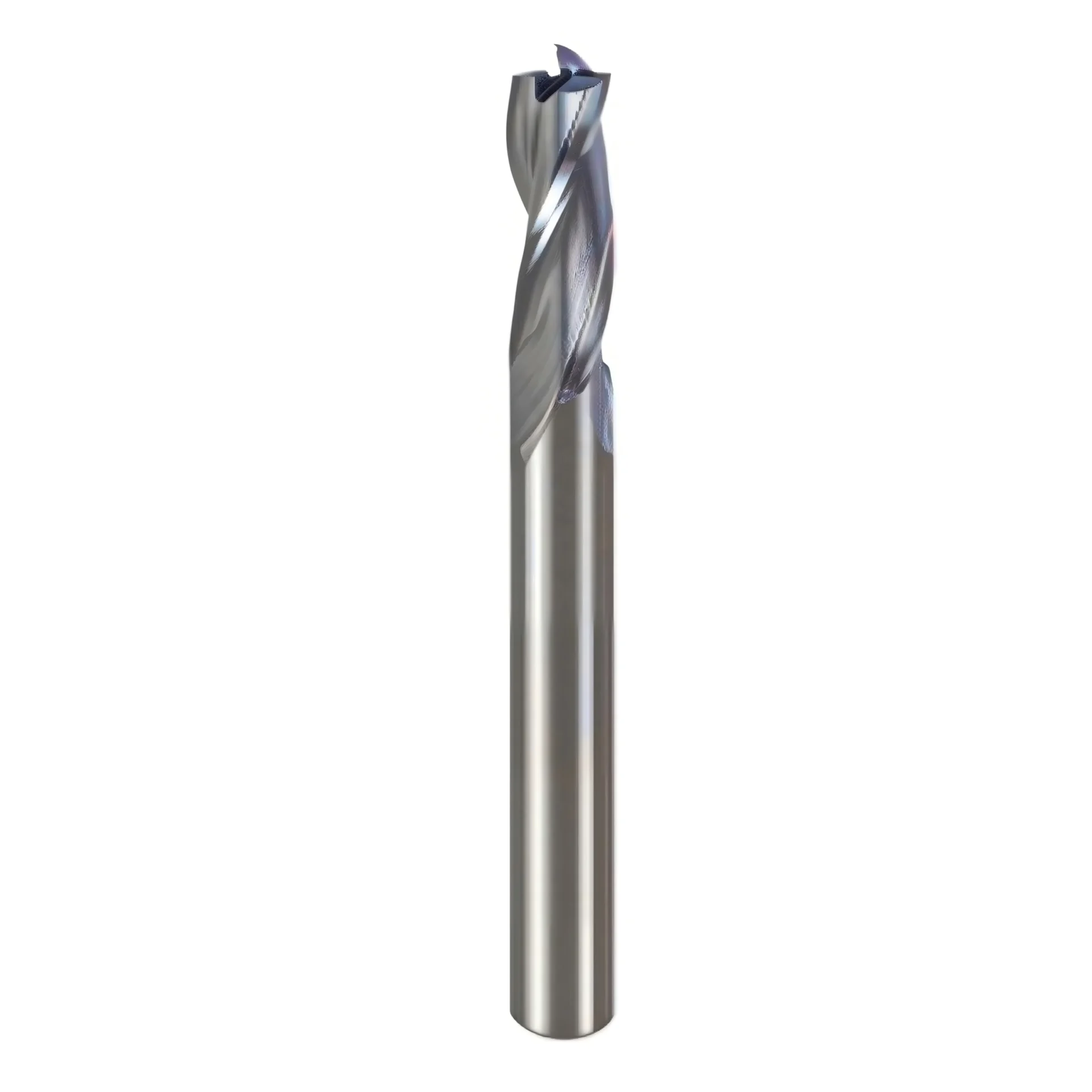
Solid Carbide Nesting Router Bits
Solid carbide nesting router bits for high-precision CNC panel cutting, sizing, and contouring. Manufactured from a single tungsten carbide rod for excellent rigidity, concentricity, and cutting consistency, with up-cut, down-cut, compression, multi-flute, and chipbreaker geometries available for demanding continuous nesting applications.
Solid Carbide Nesting Router Bits
Persistools solid carbide nesting router bits are precision CNC cutting tools manufactured directly from a single tungsten carbide rod.
Unlike TCT nesting tools that combine a steel shank with a brazed carbide cutting section, solid carbide router bits use one continuous carbide body from the shank through the cutting section.
This integrated construction provides excellent rigidity, dimensional consistency, and stable cutting performance for demanding panel machining applications.
Typical applications include:
- CNC nesting
- Full-sheet panel cutting
- Furniture component sizing
- Contour machining
- Cabinet production
- Wardrobe panels
- Door components
- High-volume panel processing
- Precision woodworking production
One-Piece Solid Carbide Construction
The one-piece carbide structure eliminates the transition between a steel shank and brazed cutting section.
This provides several practical advantages:
- Higher overall rigidity
- Better dimensional consistency
- Stable concentricity
- Reduced structural variation
- Excellent balance potential
- Stable cutting geometry during high-speed operation
For continuous CNC machining, these characteristics can help maintain consistent cutting quality over long production cycles.
Manufacturing Accuracy Matters
Solid carbide nesting router bits are highly dependent on both carbide material quality and flute-grinding accuracy.
Because the complete tool is manufactured from one carbide rod, every stage of production directly affects the final cutter.
Important manufacturing factors include:
- Carbide rod straightness
- Material consistency
- Shank diameter accuracy
- Flute grinding accuracy
- Helix geometry
- Cutting-edge preparation
- Concentricity
- Runout
- Tool balance
- Surface finish
Compared with brazed tools, manufacturing errors are more costly because the entire carbide blank may need to be rejected if the final geometry falls outside tolerance.
More Freedom in Flute Geometry
Because the cutting section and shank are part of the same carbide blank, solid carbide tools allow greater freedom in flute and spiral design.
Common options include:
Up-Cut
Provides strong upward chip evacuation and is useful when clean bottom-edge cutting is required.
Down-Cut
Directs cutting force downward and helps reduce chipping on the upper panel surface.
Compression Cut
Combines up-cut and down-cut sections to reduce breakout on both faces of laminated boards.
Cross / Opposing Helix Geometry
Uses different cutting directions along the cutting section to improve edge control and reduce chipping.
Chipbreaker Geometry
Divides chips into smaller segments, helping control cutting load and chip evacuation during continuous panel machining.
Multi-Flute Designs
Two-, three-, and other flute configurations can be produced according to the required balance between chip evacuation, surface quality, feed rate, and tool diameter.
Designed for High-Precision Continuous Nesting
Solid carbide nesting router bits are particularly suitable for applications where customers require:
- Long continuous machining cycles
- Stable dimensional accuracy
- High spindle speeds
- Good edge quality
- Reduced vibration
- Consistent tool performance
- Accurate contour cutting
The increased rigidity of solid carbide can be especially useful on modern CNC routers and machining centers with stable spindle systems and precise tool holding.
Suitable Panel Materials
Solid carbide nesting router bits can be used for:
- MDF
- Particleboard
- Plywood
- Melamine-faced panels
- Laminated furniture boards
- Solid wood
- Engineered wood
- Selected composite panels
The correct flute geometry should be selected according to the panel structure, coating, thickness, machining direction, and required edge quality.
Custom Tool Designs
Persistools can manufacture solid carbide nesting router bits according to:
- Cutting diameter
- Cutting length
- Overall length
- Shank diameter
- Number of flutes
- Helix direction
- Compression section length
- Chipbreaker configuration
- Workpiece material
- Machine spindle
- Customer drawing
- Existing tool sample
Custom flute geometries can also be developed for special panel structures and production requirements.
| Cutting Diameter | Cutting Length | Shank Diameter | Flute / Geometry | Material | Typical Application |
|---|---|---|---|---|---|
| Ø4 mm | 15–25 mm | 4 / 6 mm | 2-Flute / Up-Cut | Solid Carbide | Fine panel cutting |
| Ø6 mm | 20–30 mm | 6 mm | 2-Flute / Up / Down | Solid Carbide | General CNC nesting |
| Ø8 mm | 25–35 mm | 8 mm | 2 / 3-Flute | Solid Carbide | MDF / Laminated panels |
| Ø10 mm | 30–40 mm | 10 / 12 mm | Compression | Solid Carbide | Furniture panels |
| Ø12 mm | 30–45 mm | 12 mm | Compression / Chipbreaker | Solid Carbide | Continuous nesting |
| Ø14 mm | 35–45 mm | 12 / 14 mm | 3-Flute / Cross Helix | Solid Carbide | High-precision panel cutting |
| Ø16 mm | 40–50 mm | 16 mm | Multi-Flute / Chipbreaker | Solid Carbide | Heavy-duty nesting |
| Custom | Custom | Custom | Up / Down / Compression / Cross Helix / Chipbreaker | Solid Carbide | Special applications |
Product Type: Solid Carbide Nesting Router Bit
Material: Solid Tungsten Carbide
Construction: One-Piece Solid Carbide
Flute Options: 2-Flute / 3-Flute / Multi-Flute / Custom
Cutting Direction: Up-Cut / Down-Cut / Compression / Cross Helix
Chipbreaker: With / Without
Application: CNC Nesting / Panel Cutting / Sizing / Contouring
Processed Materials: MDF / Particleboard / Plywood / Laminated Panels / Solid Wood / Engineered Wood
Resharpening: Available Depending on Tool Geometry and Remaining Carbide
Customization: Diameter, cutting length, shank, flute number, helix geometry, chipbreaker design, and carbide grade available on request.
What is the difference between solid carbide and TCT nesting router bits?
What are the advantages of solid carbide construction?
What flute geometries are available?
Can solid carbide nesting router bits be resharpened?
If the above questions do not solve your doubts, please contact us through email or phone as well!
Persistools is fully committed to pursuing maximum efficiency in customer service and delivering premium customer experience. Whether you have pre-sales questions or encounter after-sales issues, you will receive our swift reply at all times. Our team always stays positive and dedicated to solving problems effectively.
