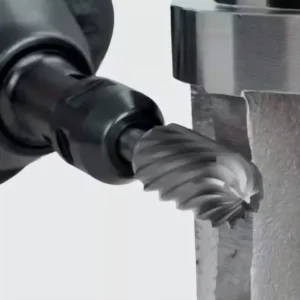
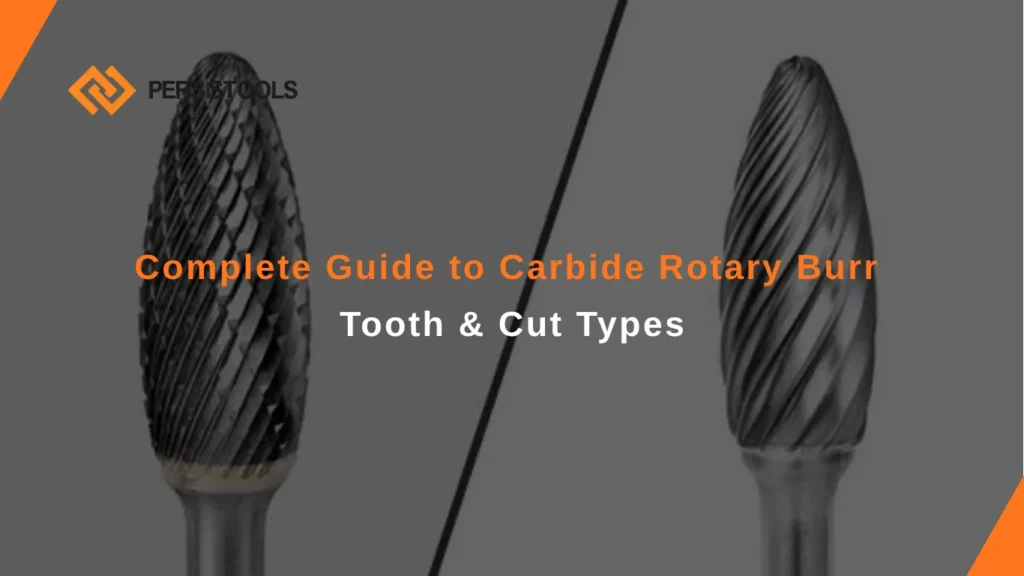
The cutting performance, chip removal, surface finish and service life of carbide rotary burrs entirely depend on tooth cut patterns. Improper tooth selection will cause chip clogging, severe vibration, rough surface and quick tool wear. Below we explain all common rotary burr tooth types, features and matching materials.
- Single Cut
The single cut features a unidirectional spiral tooth arrangement and is one of the most common tooth types. Its single-edge design offers the advantages of smooth chip evacuation, low cutting resistance, fast material removal rate, and high surface finish. It is mainly used for heavy stock removal, weld grinding, casting slag cleaning, and general rough and finish machining.
- Features: Long chip shape, anti-clogging, stable grinding
- Suitable materials: Carbon steel, cast iron, mold steel, tempered steel
- Double Cut
The double cross cut is also one of the most common tooth types. It has interlaced bidirectional tooth patterns, with the advantages of multiple cutting edges, fine chip fragmentation, minimal vibration, and no easy jumping during operation. It is mainly used for precision trimming, chamfering and polishing, narrow space grinding, and high-precision finish machining.
- Features: Powder fine chips, fast heat dissipation, smooth precision finish
- Suitable materials: Stainless steel, alloy steel, copper, wood, plastic
- Aluminum Cut
As the name suggests, the aluminum special wide cut is a tooth type specially designed for processing aluminum and aluminum alloy materials. Its extra-large tooth grooves and wide tooth pitch are specifically designed to prevent aluminum adhesion and chip clogging during processing
- Features: Large chip space, no aluminum adhesion, high-speed cutting
- Suitable materials: Aluminum alloy, brass, magnesium, soft non-ferrous metals
- Coarse Cut
The coarse cut is mainly used for rough grinding, large-scale scrap removal, and blank shaping. It has large tooth spacing, few cutting edges, strong cutting power, and can quickly remove large margins of material.
- Features: Extremely fast material removal, suitable for thick margins
- Suitable materials: Soft steel, bronze, zinc, plastic, wood
- Fine Cut
The fine cut performs excellently in processing scenarios such as mirror finishing, precision chamfering, medical hardware, and fine polishing. It has dense teeth and multiple edges, with fine cutting, good polishing effect, high precision and low roughness.
- Features: Smooth surface, low vibration, precise shaping
- Suitable materials: Hardened steel, precision mold, thin-wall parts
Quick Tooth Selection Tips
- Steel & cast iron → Single standard cut
- Stainless steel & alloy → Double cut
- Aluminum & soft copper → Aluminum cut
- Heavy rough machining → Coarse cut
- Precision finishing → Fine cut
Reasonable matching of carbide rotary burr tooth profiles not only effectively improves processing efficiency and extends tool service life, but also greatly reduces after-sales maintenance and repair costs.
Persistools supply all standard & customized carbide rotary burr teeth, and with our advanced CNC tooth grinding machines, we can tailor tooth patterns according to the specific workpiece materials required by our customers, which is one of the key reasons why we have maintained a leading position in the carbide rotary burrs industry.
If you are looking for a reliable and professional carbide rotary burr supplier or have any questions about tooth type selection and customization, please feel free to contact us anytime.