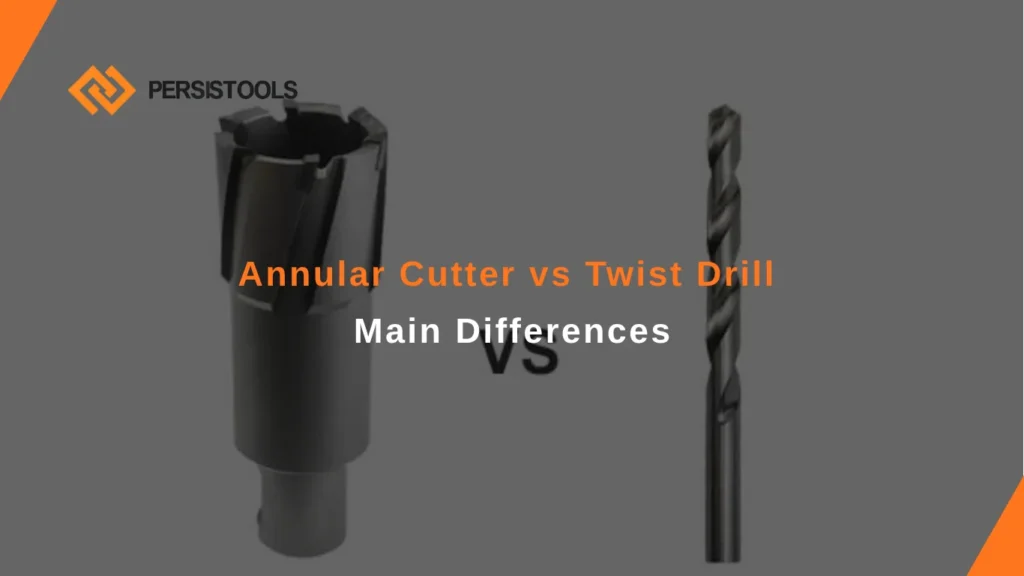
In metal drilling operations, annular cutters (also called core drills / hollow drills) and twist drills are the two most widely used cutting tools. Their fundamental differences in cutting principle lead to clear gaps in drilling efficiency, precision, total cost and suitable scenarios. This guide breaks down their main differences in a professional, easy-to-understand way, to help global buyers and operators make the right tool selection.
Core Root Difference: Cutting Principle & Structure
This is the source of all performance gaps between the two tools.
Annular Cutter: Adopts circular ring cutting. It only cuts the outer ring of the target hole, leaving the solid inner core material intact. The actual cutting area is only 15%-30% of a twist drill with the same hole diameter, significantly reducing invalid cutting work.
Twist Drill: Adopts full solid cross-section cutting. It needs to cut and remove all metal inside the target hole, with large cutting volume, long cutting stroke and high invalid workload.
4 Key Dimensions Comparison
- Drilling Efficiency
Annular cutters have an overwhelming efficiency advantage, which becomes more obvious with larger hole diameters and thicker steel plates.
With lower cutting volume and multi-blade symmetrical design, annular cutters work at an optimal cutting speed of 35-45m/min, 125% higher than twist drills (15-20m/min). Its drilling efficiency is 3-10 times that of standard twist drills under the same working conditions.
Field test data: Drilling 10 holes of 24mm diameter on 25mm thick structural steel plate, a TCT annular cutter finished in 8 minutes 25 seconds, while a twist drill only completed 4 holes in the same period.
- Drilling Precision & Finish
| Comparison Factor | Annular Cutter | Twist Drill |
| Centering Performance | Self-centering with multi-blade cutting, no hole deviation or oversize | Easy to drift, requires pre-drilled center holes for positioning |
| Hole Wall Quality | Minimal roundness error, finish up to Ra3.2, burr-free, no secondary finishing needed | Rough hole wall, easy to have scratches and steps, often needs secondary reaming |
| Verticality | Stable verticality with magnetic drill, suitable for high-precision bolt connection | Easy to have inclined holes, hard to control verticality in manual operation |
- Total Cost Comparison
Upfront Single Tool Cost: An annular cutter has a higher initial purchase cost than a twist drill of the same specification.
Long-term Total Cost: For medium-large holes (≥φ12mm) and batch drilling, the service life of an annular cutter is 8-10 times that of a twist drill. It reduces tool change frequency and regrinding needs, cutting total labor and consumable cost by over 45%. The intact core material from annular cutters can also be recycled, further reducing material waste.
Cost Advantage Boundary: Twist drills have lower single-use cost only for small holes (<φ12mm) and one-off scattered drilling.
- Suitable Equipment & Application Scenarios
Annular Cutter: Best For Compatible Equipment: Magnetic drill, radial drill, milling machine, boring machine (mainly industrial heavy-duty drilling equipment)
Core Scenarios: Thick plate (≥5mm) and medium-large hole (φ12-φ150mm) drilling for steel structure engineering, shipbuilding, railway & bridge construction, machinery manufacturing. Especially suitable for high-altitude on-site construction and high-volume continuous industrial processing.
Twist Drill: Best For Compatible Equipment: Hand drill, bench drill, radial drill, CNC machining center (universal for hand-held and bench-top equipment)
Core Scenarios: Thin plate and small hole (φ0.3-φ20mm) drilling, compatible with metal, wood, plastic and other materials. Suitable for bench precision machining, scattered drilling, DIY and non-industrial projects.
Quick Selection Guide
For thick plate, medium-large hole, batch on-site construction, choosing annular cutter for maximum efficiency and long-term cost saving.
For thin plate, small hole, multi-material scattered drilling, choosing twist drill for flexible universal use and low upfront cost.
As a professional manufacturer specializing in R&D and production of high-end industrial drilling tools, we provide a full range of HSS and TCT annular cutters in diameter 12 to 100mm specifications. We support non-standard customization and OEM services, with products suitable for harsh working conditions in steel structure, shipbuilding, railway and other industries. For tool selection guidance or product inquiry, please feel free to contact our professional team.